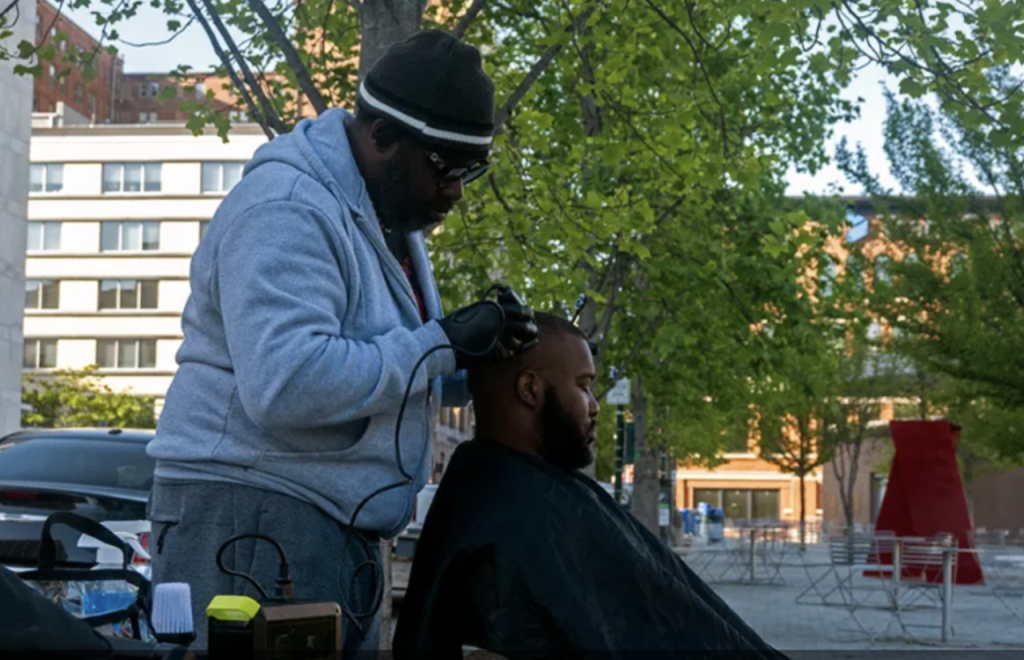
There’s no striped pole or hydraulic kick leather chair. No sign posted on a door about hours of operation or holidays off. It’s just Bryan Slayton and his barber tools laid out on his mobile cart plugged into the city’s power outlet.
His clients sit on a chair pulled from a park table. On a good day, you can see people lined up waiting for a new do, sometimes not so many. Regardless, he stays from 8 am until noon, waiting to make someone’s day.
Slayton is a Chattanooga barber making a difference for those less fortunate in the community. You can find him at Miller Park every Wednesday with his clippers and barber tools set up at his side. He gives haircuts to anyone in need. They just walk up to his improvised office and ask.
Slayon grew up in Chattanooga’s West Side projects and received his first pair of second-hand clippers at 10 years old as a Christmas gift from his uncle. He mastered his craft through trial and error, but in the beginning it was just a side hustle.
In his late teen years, the main source of Slayton’s income came from selling crack cocaine. Due to increased law enforcement around substances, marijuana had suddenly become hard to find, and a new drug emerged. Slayton recalled the summer after his junior year of high school. “That summer something happened, weed just disappeared and all of a sudden, boom! Crack! At the time, nobody knew what crack was,” he said.
Despite the many dangers, selling crack cocaine introduced Slayton to a richer quality of life he never experienced. Rather than shopping at thrift stores, he bought brand new shoes and clothes. Suddently, he could take his mom out for fresh meals and buy a nice car. This criminal lifestyle brought Slayton material luxuries, but it wouldn’t come without consequences.
In 1989, shortly after leaving high school, Slayton was sentenced to 31 years in prison for selling crack cocaine. Today, the legal system would consider this sentence an obscene amount of time for a non-violent crime.
During the late 1980’s, law enforcement targeted black youth in impoverished inner cities.
President Reagan’s Anti Drug Abuse Act of 1986 instructed federal courts to sentence an individual possessing 5 grams of crack cocaine the same as an individual holding 500 grams of powder cocaine. Crack cocaine, made from powder cocaine with other additives, was cheaper. Consequently, the new drug became popular in impoverished urban areas which inordinately affected black communities. Powder cocaine was more of a drug of choice for the wealthier white demographics. This meant many black people received much harsher sentences for committing the same crime as white people.
“They threw us away, and I went to prison,” Slayton said.
While in prison, Slayton continued to cut hair to support himself and earn respect and safety behind bars. He wasn’t the prison’s designated barber. Instead, he worked out of his unit with the supplies he managed to get his hands on. He would cut hair with a makeshift tool crafted from just a comb and razor blades, and a toothbrush to clean up the edges.
Slayton was released from prison at age 49.
In 2021, Senator Bob Corker, along with other government officials, helped Slayton receive a pardon, along with 16 others who were punished in Tennessee during President George H.W. Bush’s term.
Three years ago, Slayton was outside cutting his friend’s hair when a woman approached him and asked for a haircut. She appeared to be struggling so he agreed to cut her hair for free. Suddenly, another man came asking for a haircut. He was about to go to a job interview, and Slayton agreed to help him out. Days later, the man approached Slayton on the street stating, “I got the job, man, I got the job!”
From that day on, Slayton decided to use his talent to help those in need get a better chance in life.
“Sometimes a kind word can go farther than a meal or a couple of dollars,” Slayton said.
He reflected on the motivations behind his practice.
“I don’t owe them, they don’t owe me. I have the time, and I have the skill. What I’m doing now is small. Some people may think it’s a waste of time, but I don’t think so,” Slayton said.
In every cut he gives, Bryan isn’t just stylizing hair he’s shaping second chances one person at a time.
Leave a Reply