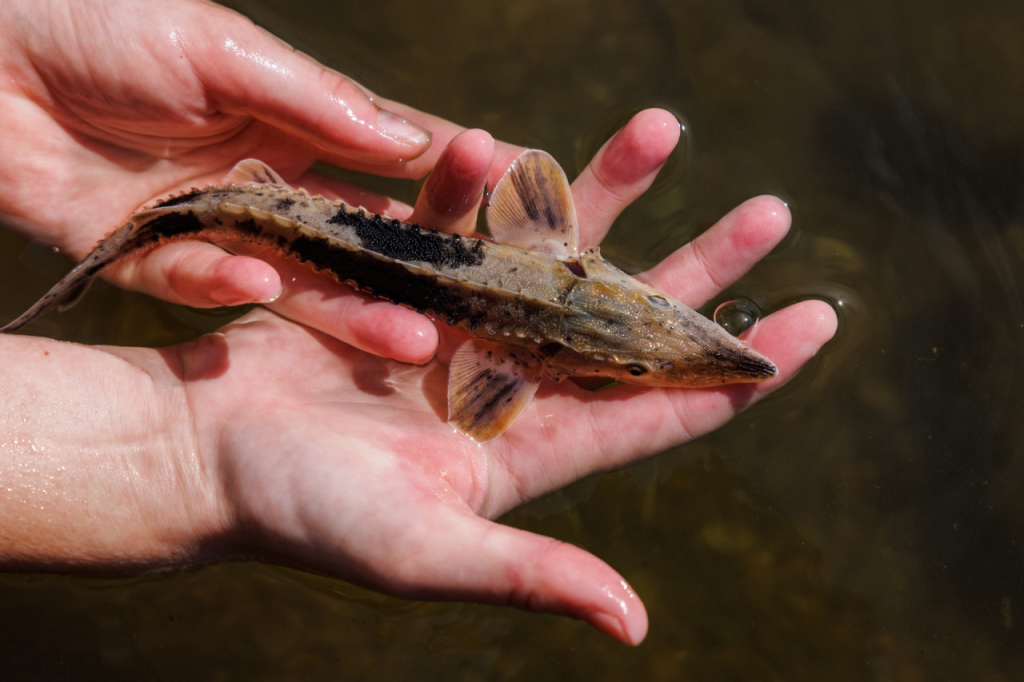
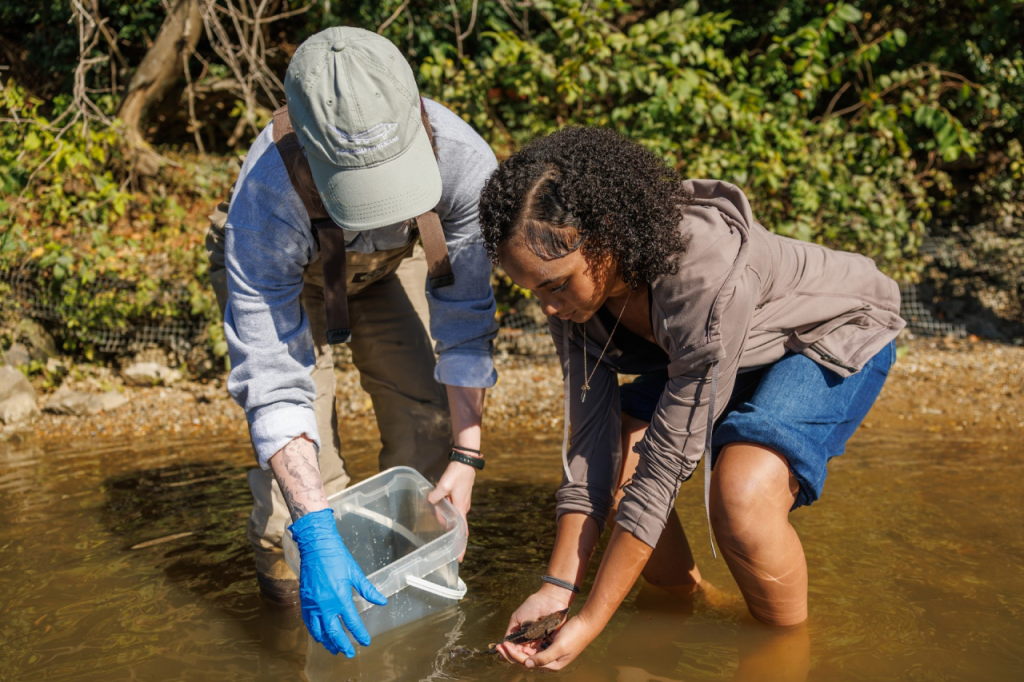
Conservationists, community leaders, students and other special guests gathered on Oct. 23, 2025 on a small boat launch below Market Street Bridge in Chattanooga for the Tennessee Aquarium Conservation Institute’s (TNACI’s) 25th anniversary Lake Sturgeon release. Attendees released approximately 500 juvenile Lake Sturgeon, into the Tennessee River, and watched as they swam into what will hopefully be long, healthy lives.
“It’s a really cool day to be able to share,” said Teresa Israel, TNACI’s reintroduction biologist. “It’s something that really drives public interest.”
TNACI officials instructed attendees on how to properly handle and release the baby sturgeon. They were surprisingly squirmy and required a strong but delicate grip as they were lowered into the shallow water on the river’s shore.
Lake Sturgeon is a freshwater fish that can get up to seven feet long, weigh 300 pounds and live up to 150 years. They appear in fossil records from more than 100 million years ago when they coexisted with dinosaurs.
These ancient fish live in parts of the United States and Canada, but in the 1970s, they disappeared from the Cumberland and Tennessee River systems. Experts blame overfishing, pollution and damming of rivers.
In 1998, conservationists formed the Southeast Lake Sturgeon Working Group, which is a collaborative partnership between non-profits, such as TNACI, the University of Tennessee, other universities, and state and federal agencies. Two years later, they began reintroducing Lake Sturgeon into the Cumberland and Tennessee Rivers.
“We have a…genetically diverse, relatively big population of Lake Sturgeon out in the Tennessee River now, because we’ve been stocking for 25 years,” said TNACI’s Aquatic Conservation Biologist Dr. Bernie Kuhajda.
“It was a group effort, this large-scale reintroduction program,” Israel said. “We definitely couldn’t do it on our own. We aren’t able to raise the eggs here, so we depend on Warm Springs National Fish Hatchery to be able to do the actual spawning, raise the eggs, and then provide us with the juveniles.”
In 2018, the Center for Biological Diversity petitioned U.S. Fish and Wildlife Services (USFWS) to federally list Lake Sturgeon as endangered. After a comprehensive review of Lake Sturgeon populations, USFWS decided that classifying them as endangered was unwarranted because conservation efforts helped the species recover in some areas. The reintroduction efforts of the Southeast Lake Sturgeon Working Group are partly responsible for this win.
Marine biologists will continue helping the sturgeon until they are confident the population is strong enough to survive on its own.
Overfishing and pollution are no longer dangers for the Lake Sturgeon. When they were listed as a “State Endangered” species in the 1970s, fishing for them became illegal. Enforcement of the Clean Water Act in 2013 prevented raw sewage from being dumped into the Tennessee River, so the water is much cleaner and a more suitable habitat for the sturgeon today.
Unfortunately, damming is still a problem, but “there’s hope that the fish are actually able to move across them,” Israel said.
The biggest concern is the Lake Sturgeon larvae will not survive their larval drift stage once they start spawning in the wild. During larval drift, the sturgeon need to drift in the water currents 16 kilometers downstream on average, feeding on zooplankton.
“We’ve got so many dams and reservoirs on the Tennessee River, there may not be enough free-flowing river below those dams for those larvae to be able to ride the currents and stay up in the water column,” said Kuhajda. “If they have to stay up there by swimming, they’re going to burn more energy than they eat.”
If the larvae are not able to survive larval drift, there are solutions. Israel said Washington state has started a program that collects the Lake Sturgeon during larval drift and head starts them, rather than going through the process that TNACI and their partners do where they pull adult fish to spawn the eggs and create the babies.
“They’re allowing for natural mate selection,” said Israel. “That’s something we could look into in the future if there’s not enough room for larval drift. Hopefully we’ll see some spawning and get to make those next steps pretty soon.”
Another challenge the program faces is tracking the Lake Sturgeon after their release. Members of the working group remove two of the sturgeon’s scoots which are the bony plates down their side. Each hatchery in the working group removes the same two scoots every year, so in the future if one is caught, they will know which year it was released. If a juvenile is caught that has no scoots removed, they will know natural reproduction has occurred and been successful.
“This year [we all removed] two and three on the left side,” Israel said. “That way, in the future…we know it came from the class of 2025.”
Kuhajda said that it takes 15 to 20 years for male Lake Sturgeon to become sexually mature, and 20 to 33 years for the females. TNACI and their partners anticipate natural reproduction to happen soon considering that the sturgeon they released at the beginning of the program in 2000 are starting to reach sexual maturity.
In fact, officials at the Tennessee Wildlife Resources Agency (TWRA) found evidence of reproduction in the wild. According to Kuhajda, earlier this year, TWRA collected a Lake Sturgeon from the Cumberland River to insert a tracking tag. When they made the incision, she was full of eggs, raising hopes for successful natural spawning. TNACI began reintroduction efforts in the Cumberland River several years after the Tennessee River, so there are likely mature females in the Tennessee River as well.
“We are bringing back another piece of the aquatic ecosystem, and the healthier the aquatic ecosystem is, the better it cleans the water, and the better it is for all the critters that live out there and the better for us humans,” said Kuhajda.
EDITOR’S NOTE: This story was produced in Fall 2025 for Prof. Jim Tanner’s Solutions Journalism reporting class which allowed students to investigate and report on environmental issues being addressed in the Chattanooga area. Solutions Journalism is a journalism framework developed in 2013 to investigate and explain, in a critical and clear-eyed way, how people try to solve widely shared problems in their communities.
Leave a Reply