Once known for its tuberculosis death rate at three times the national average, its air choked with pollution, and holding the gloom-ridden title of “America’s Dirtiest City,” Chattanooga is now earning national attention for its efforts to rebuild itself around sustainability and a community-centered green designation.
Today, the city is no longer bleak but empowering and triumphant. Once defined by smog and environmental crisis, Chattanooga moves forward with green initiatives.
In April 2025, the city officially received the title “National Park City” becoming the first city in North America to join the international National Park City movement.
In 2023, Chattanooga began this journey. Local leaders felt the timing was right. Decades of environmental improvement had set a foundation the city was finally ready to show off.
A city designated as a National Park City reflects everyday access to nature, sustainable urban design, and collective responsibility for environmental well being. “A National Park City is a place, a vision and a city-wide community that is acting together to make life better for people, places and nature,” according to the National Park City Foundation.
“Here in Chattanooga, we’ve used the National Park City movement to encourage folks to think
about Chattanooga as a city in a park, rather than a city with some parks in it,” said Chattanooga
Mayor Tim Kelly in a City of Chattanooga YouTube video. “We’ve always known how special
Chattanooga’s connection to the outdoors is, and now it’ll be recognized around the world. I
could not be prouder that Chattanooga is North America’s first National Park City.”
In 1969, the U.S. Department of Health, Education, and Welfare (HEW) named Chattanooga the
“worst city in the nation for particulate air pollution,” according to the City of Chattanooga
website. Chattanooga was a hot spot for industries, iron and steel products, glass manufacturing, and was most widely known for its railroad system. All contributed to the extreme amounts
of pollution.
Public pressure eventually pushed city leaders to act, and by 1968, the city met all federal air
quality standards. Between 2008 and 2018, Chattanooga reduced carbon emissions by 25
percent. Milestones like this set the groundwork for the city’s current sustainability efforts.
Kelly added in a recent interview the National Park City designation gives the Chattanooga a unified direction. “We all talk about economic growth as the north star,” he said. “But we didn’t really have an organizing principle for our sustainability strategies. The National Park City provides us with that.”
Chattanooga’s sustainability work now centers on green infrastructure using natural processes to
manage storm water, reduce flooding, cool the city, and improve overall ecological health.
Morgan McCormick, director of Parks Stewardship and Maintenance, said financial limitations
remain the biggest challenge in scaling these projects.
“Everything takes money and time. Training the workforce, expanding programs, developing and
implementing new ones,” she said.
The city’s progress still continues in measurable ways.
“We have seen reductions in electricity costs annually since we started converting to LEDs and
motion sensors,” McCormick said. Her team also uses the Trust for Public Land’s 10-minute
walk metric to determine where new parks and accessible green spaces are needed most.
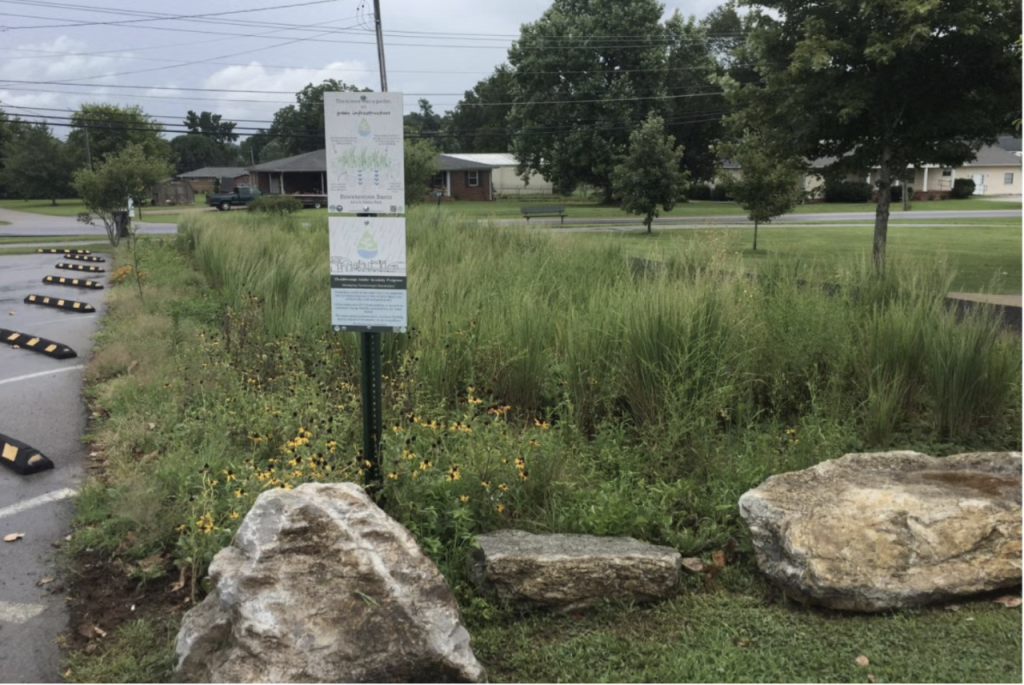
One of the city’s most impactful recent projects is Lynnbrook Park, completed in July 2024.
McCormick chose it as a standout example of what green infrastructure can accomplish.
“What started as an asphalt parking lot in a neighborhood prone to flooding is now a 1.4 acre
park with a stream bed for stormwater control,” she said.
The park’s walking paths were built with a honeycomb grid filled with crushed stone, a design that “allows stormwater infiltrate, rather than the runoff created by asphalt,” McCormick said.
The benefits also stretch further than just stormwater management.
In summer 2025, McCormick said Chattanooga city staff observed monarch butterflies, an endangered species, along with monarch caterpillars feeding on swamp milkweed planted in the stream buffer.
“It’s proof that even small neighborhood parks can become habitat,” she said.
A large project that took place in Chattanooga was the Cherokee Boulevard from North Market
Street to the Stringers Ridge Tunnel. This project was designed to manage stormwater runoff. The total cost of the project was $719,800, and stormwater runoff declined 8%.
Lynbrook Park and the tunnel project on Cherokee Boulevard are part of a broader city-wide push to build infrastructure that benefits people and nature at the same time. Many municipal buildings
now incorporate permeable surfaces, green roofs, or native plantings. Meanwhile, the
Chattanooga Tree Project, funded by a five year $6 million federal grant, is expanding the city’s
shade canopy and stormwater resilience.
McCormick believes this long-term effort will ultimately become the city’s most transformative
sustainability project.
“Mature trees are our first line of defence against stormwater issues and the urban heat island
effect,” she said. “As thousands of baby trees are planted and mature, I believe this project will
become the most impactful green infrastructure project the city will implement.”
Mayor Tim Kelly said the work ahead is about balance and continued commitment. “We have to continue to grow, to better the lives of everybody here,” he said. “Economic mobility is a big priority; so is sustainability. They’re not irreconcilable.”
EDITOR’S NOTE: This story was produced in Fall 2025 for Prof. Jim Tanner’s Solutions Journalism reporting class which allowed students to investigate and report on environmental issues being addressed in the Chattanooga area. Solutions Journalism is a journalism framework developed in 2013 to investigate and explain, in a critical and clear-eyed way, how people try to solve widely shared problems in their communities.
Leave a Reply