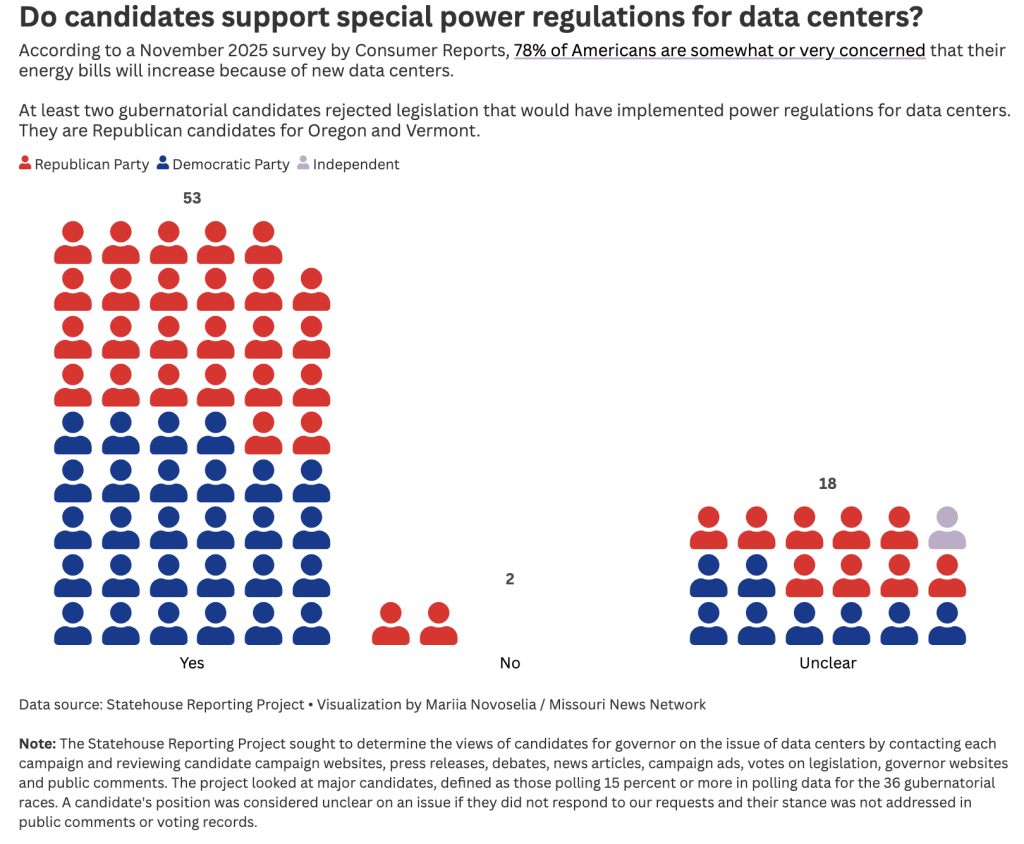
More than half of candidates in governor’s races across the country in 2026 have aligned on one key issue in the contentious debate over data centers — there must be rules in place on how facilities consume energy.
Some candidates from both major political parties are changing their public stances as the centers become more controversial.
Some argue data centers must cover the total cost of their energy needs. Others add they should build their own power generation or expand state energy resources. The issue is top of mind as residents grow concerned over rising energy prices linked to data centers.
A team of reporters from the Statehouse Reporting Project examined public comments, news reports, debates, campaign material and email responses to gauge how some candidates for governor are addressing the issues ahead of the Nov. 3 election.
Jerri Green, the Tennessee Democratic candidate for governor, expressed a similar fair-share sentiment in a post to her Substack on Aug. 17. Green is challenging Republican Sen. Marsha Blackburn.
“If a data center requires massive new electrical infrastructure, the company creating that demand should pay its fair share. Tennessee families shouldn’t see their utility bills increase to subsidize some of the world’s wealthiest technology companies,” she said.
Blackburn agrees ratepayers should be shielded from additional costs. She’s called for “thoughtful” decisions about the location of the centers, but supports their continued development.
“Data centers are going to be a good and important part of Tennessee’s economic growth,” Blackburn said while discussing a controversial proposal that placed a data center near the Nashville Zoo. “But we’ve got to be thoughtful about their placement.”
In addition to finding more candidates taking stronger stands on slowing the growth of the centers, the research shows that a number of candidates are taking vague positions, making general comments about supporting “guardrails” on development without stating what those might look like.
Growing data center development transformed the topic from a largely hypothetical controversy into a real political dispute, according to Matt Harris, an associate professor of political science at Park University in Parkville, Missouri.
Democrats are more likely than Republicans to view the facilities as negative, but their unpopularity is growing more bipartisan, according to a survey by Pew Research Center published in September.
“I think data centers are probably more important now as an issue than they were even six months ago,” said Harris, who studies American politics and political campaigns.
More than one-third of candidates have vowed to implement the state-level measure as governor, though by a slim margin, including Kansas Democratic state Sen. Cindy Holscher and Ohio Republican entrepreneur Vivek Ramaswamy. Ramaswamy pledged to implement a moratorium his first day in office until lawmakers pass data center legislation aligned with his policy objectives on electricity bills, property taxes and environmental standards.
Dan Cox, a Republican from Maryland and a former state delegate, has gone further, saying he would work to permanently ban the facilities.
“I’m calling for an immediate statewide ban on new mega data center approvals while we push to enact the permanent ban,” Cox said on Oct. 21.
Republican Sen. Tommy Tuberville, who is running for Alabama governor, co-sponsored the federal Ratepayer Protection Act in the Senate, which would encourage states to adopt a federal standard requiring large load facilities to cover the total amount of their energy costs to protect consumers. The House version of the bill failed in the Senate.
Data centers in Alabama would be required to pay the full cost of their electricity and water infrastructure and replace the water and power they consume under Tuberville’s administration, he said in an op-ed published in the Alabama Political Reporter in September.
“They can build their own power generation or pay into a fund that expands Alabama’s energy capacity and lowers costs for our people,” he said. “Data centers should leave Alabama’s infrastructure stronger than they found it.”
Parkville University professor Matt Harris said the importance of data centers in the political landscape will grow over time. It’s a matter of more people feeling the effect and developing opinions.
While the partisan line remains muddy, he expects more clarity to emerge over the next few years.
“I would imagine (data centers) will be a more important issue in 2028 and maybe even more so after that,” Harris said.
The effect of data centers on the midterms will likely remain limited in 2026, Harris said. They may carry more weight in states with close races, but in others, the cost of living and inflation will be more important to voters.
“People have opinions on data centers,” Harris said. “They’re largely negative. But if you rank the issues in terms of importance, it’s probably not super high on that list, unless you live somewhere where they’re proposing building a data center right next to your house or in your town or something like that.”
This story was reported by Maddie Carr, a reporter and journalism master’s student at the University of Missouri. Max Ulz of the University of New Mexico, Bria Demand, Conor Sexton and Natalie Keller of the University of Kansas and Devin Kraber, Hudson Kuechler and Jackson Cooper of the University of Missouri contributed reporting. Twenty-nine students from the University of Missouri and the University of Kansas and one student from the University of New Mexico collected candidate information.
Leave a Reply