In this issue, we’re sharing several important website updates, including the approved retheme design, accessibility progress, Silktide changes, the next deployment date and a behind-the-scenes Schema improvement.
Some updates require action from editors. Others are simply good to know. Either way, the goal is the same: a clearer, more accessible and easier-to-manage university website.
Action Needed: No action needed from editors right now.
Retheming Update: The New Design Has Been Approved
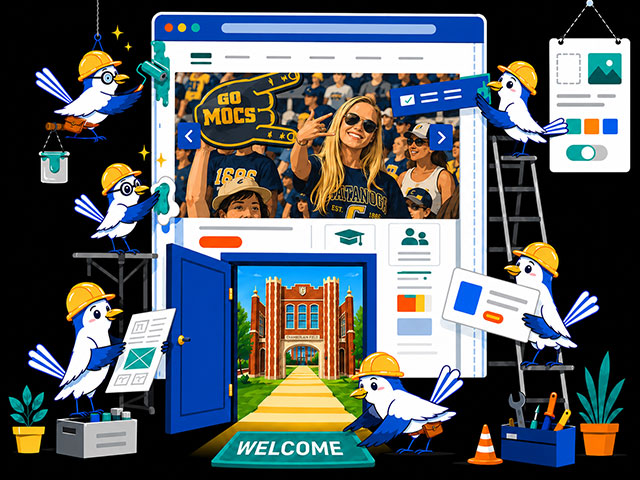
Our university website retheming project is now underway, and the new design has recently been approved.
This is an important step. Our current website theme is five years old. Five years may not sound like much, but on the web, that is a pretty long time. User habits change. Mobile expectations change. Accessibility expectations change. And content editors are still expected to keep everything accurate, current and organized. Naturally.
The new design gives us a stronger starting point for modernizing the university’s digital front door.
Why This Matters
The website is often the first place prospective students, families, current students, faculty, staff and visitors go for information.
A stronger website experience helps people find what they need faster, whether they are looking for a program, an office, a form, an event, admissions information or student support.
The new design is not just about appearance. It is about improving how the site works for:
Prospective students
Current students
Faculty and staff
Content editors
Accessibility
Recruitment
Search
Mobile users
Marketing and communications
Long-term site maintenance
A website should not feel like a maze. It should feel like a front door. Ideally, one that opens.
What’s Improving
The approved design is only one part of the larger project. The bigger goal is to build a better, more accessible and more manageable website for years to come.
Planned improvements include:
A fresh, more modern look and feel
A new content workflow and content moderation system
A better menuing and navigation system
Responsible AI integration
Improved accessibility
Stronger first impressions
Clearer calls to action
Better program discovery
Stronger storytelling
Better mobile experience
Faster access to admissions information
Improved brand consistency
Better support for marketing and recruitment campaigns
Moving to Drupal 11
We are also preparing for Drupal 11, which gives us a stronger foundation for the next phase of the website. Drupal describes Drupal 11 as supporting structured content, workflows and content governance, which lines up with the kind of long-term improvements we need.
For editors and site managers, the practical benefits may include:
More modern platform support
Better long-term maintenance
Improved editor experience, especially with AI integration
Stronger content governance
Cleaner development practices
Better performance opportunities
Accessibility support
Readiness for future Drupal improvements
This does not mean every problem magically disappears. If only. But it does give us a better base to build from.
How This Helps You!
Improved components, better workflows and clearer menus should make editing easier and more consistent.
That means fewer confusing choices, fewer avoidable errors and clearer guardrails before content is published.
The approved design is a major step, but the full project is bigger than a new look. It is about building a website that works better for visitors and the people who manage it.
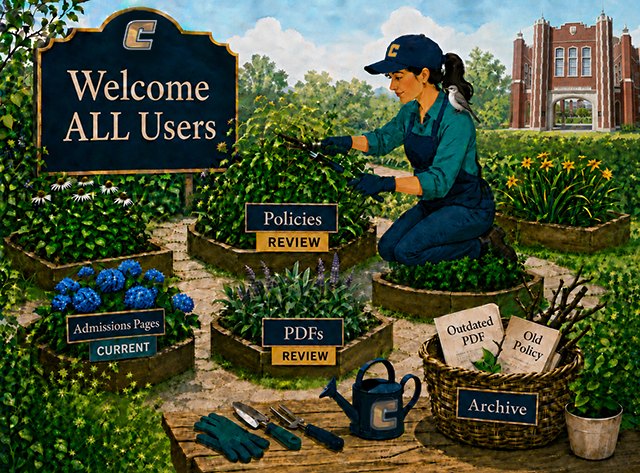
The Deadline Moved, but Some Weeds Are Still There
Action Needed: Review pages and documents. Remove, archive or update outdated content where appropriate.
Accessibility Update: The Deadline Has Been Extended
The Department of Justice has extended the Title II web and mobile app accessibility compliance deadline for larger public entities to April 26, 2027. The DOJ also confirms that the rule uses WCAG 2.1, Level AA as the technical standard for covered web content and mobile apps.
The extra time is helpful, but it does not mean we are slowing down. Because our garden won’t weed itself. It gives us more time to audit our websites, review uploaded files, remediate PDFs and archive outdated documents where appropriate.
Our goal remains the same: to move full throttle toward making our websites as accessible, useful and welcoming as possible for all users.
Good News: DocHub Is Coming
UT System is currently implementing DocHub for bulk PDF remediation as part of its new YuJa Panorama contract. ETA is in the next one to two months, so be on the lookout for information regarding training!
YuJa describes Accessible DocHub as a centralized, cloud-based tool for managing documents with accessibility in mind. It includes organization, filtering, accessibility scoring and remediation guidance, which should help support large-scale document review work.
That is good news, especially considering the number of PDFs across university websites. But it is not a magic button. Content owners will still need to help identify current documents, remove outdated files and make better choices going forward.
What This Means for You!
This work is manageable when we approach it one page, one file and one decision at a time.
Please continue to:
Review your pages for outdated content
Remove or archive documents that are no longer needed
Avoid uploading PDFs when a regular web page would work better
Make sure new documents are accessible before posting
Use clear link text instead of “click here”
Add helpful alternative text to meaningful images
Keep headings, lists and tables simple and clear
Ask whether each file or page is still useful to students and visitors
Common items to review include forms, handbooks, meeting minutes, flyers, program sheets, policy documents and admissions materials.
Accessibility is not just about meeting a deadline. It is about making sure everyone can access the information and services they need. Less jungle. More pathways.
Please reach out to us if you have questions, comments, or concerns.
Silktide Is Going Statewide
Action Needed: Continue using Silktide as usual until told otherwise.
What Is Silktide?
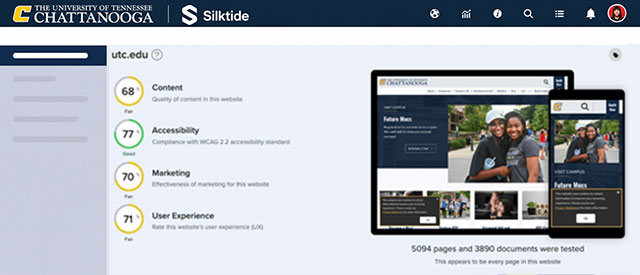
Silktide is a website quality tool that helps us find and fix issues across our sites. It can help identify accessibility problems, broken links, spelling and grammar issues, content quality concerns and policy items. Silktide describes its content tools as checking spelling, grammar and broken links, among other website quality items.
In plain language, it helps catch website problems before visitors do. That is usually preferable. Visitors are very good at finding broken things, but it is not really the workflow we are aiming for.
Silktide Is Expanding Across UT System
UT System has procured a systemwide Silktide contract, making Silktide available to all our campuses and institutes across Tennessee.
Our campus has been a longtime Silktide user and advocate, and our experience helped support broader adoption across the UT System. So, you know. You’re welcome, Tennessee.
What Is Changing
Over the upcoming months, our existing Silktide account will be migrated into the new UT System account.
This transition will happen over time. More information will be shared as details are finalized.
What This Means for You
No immediate action may be needed right now.
Editors should continue using Silktide as usual until told otherwise.
Access, reporting, dashboards or workflows may change during the migration.
Additional instructions or training information will be shared when available.
Please continue your regular content review and accessibility work. More information will be shared as the transition moves forward.
June 26 Is Bringing an Eraser
Action Needed: Save or move anything important from the test site before June 26, 2026.
Maintenance Is Scheduled for June 26, 2026
The next website deployment is scheduled for June 26, 2026. During this maintenance window, the test site will be overwritten by the live site.That means any pages, edits, uploads or other work created only on the test site may be lost when the live site replaces the test environment.
In other words, if it only lives on the test site, it may not live there much longer.
What Content Editors Need to Do Before June 26
Before June 26, please review any work currently saved only on the test site.
If the work is important, save it somewhere safer:
Create or save the work on the live site and leave it unpublished until it is ready.
Save the content in a Word document or another safe location.
Keep copies of any text, images, files or links you may need later.
Check any pages, uploads or edits that exist only on the test site.
Move or copy anything you do not want to lose.
The main idea is simple: if you need it later, do not leave it only on the test site.
We Made a Study Guide for Search Engines. You’re Welcome.
Action Needed: No action needed from editors.
Schema Has Been Added
We have recently added Schema to the website.
Schema is also called structured data. That sounds more complicated than it is.
Think of Schema like labels on a file folder. The labels do not change what is inside the folder, but they help someone understand what the folder contains.
Schema works the same way for search engines. Google explains that structured data gives search engines clearer information about a page and helps classify the page content.
What Schema Helps Describe
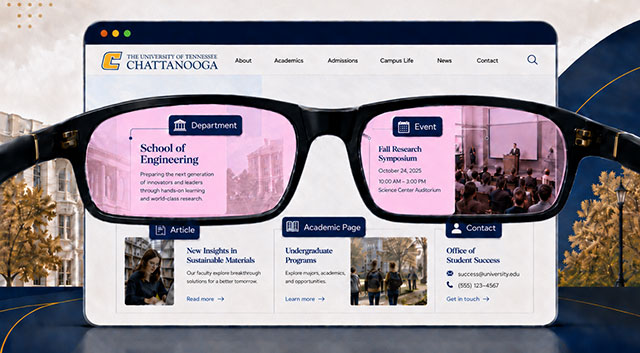
Schema helps search engines better understand information such as:
University departments and offices
Contact information
News articles
Events
Academic content
General website pages
This does not mean search rankings automatically improve. That would be nice, but search engines are not vending machines. You do not insert Schema and receive first place.
It does mean we are giving search engines a stronger foundation for reading and understanding our content more clearly. Kind of like a study guide.
What This Means for Editors
No action is needed from content editors.
This update has already been added behind the scenes.
Editors should continue focusing on the things that still matter most:
Accurate page titles
Clear headings
Current contact information
Helpful links
Up-to-date content
Simple, useful page structure
Schema helps search engines understand our content, but good content still has to be good content. The label on the folder helps, but the papers inside still need to make sense.
Part of Ongoing Website Improvement
The Schema update is part of our ongoing work to improve search, accessibility, content quality and the overall website experience.
So, good news: nothing new for editors to do.
Even better news: the website quietly got a little smarter behind the scenes…and we gave search engines the class notes.
Developer Spotlight: Steven D. Shelton
Digital Development Librarian | Associate Professor | UTC Library | Library IT
Did you know UTC’s web team extends beyond our group in the Division of Communications and Marketing? We are fortunate to work with two talented developers in Library IT—Steven Shelton and Natalie Wright—who support major web projects, including the upcoming retheme. This month, we’re introducing you to one of those partners: Steven Shelton.
Steven builds and supports the systems behind many of the library’s online tools—everything from web applications to integrated services that help students and faculty access resources more easily.
Eleven years at UTC, Steven says he enjoys being a developer because it combines problem-solving with creativity. Each project is an opportunity to build something meaningful that improves how people access and use information. He also appreciates that the field is always evolving [ain’t that the truth!], which keeps the work both challenging and rewarding.
So a big shout-out goes to Steven for his tireless support of all-things UTC and Drupal!
June 26, 2026: Next website deployment. Save or move anything important from the test site before this date.
January 1, 2027: Targeted date for incremental rollout of new theme.
April 26, 2027: DOJ Title II web and mobile app accessibility compliance deadline for larger public entities.
Upcoming months: Existing Silktide account migration into the new UT System account.
Thank You
Thank you for the work you do to keep university web content accurate, useful and accessible.
These updates are part of a larger effort to make the website easier for visitors to use and easier for editors to manage. Small updates, made consistently, make a big difference.
And yes, sometimes the small update is deleting an outdated PDF from 2016. It may not feel heroic, but in website terms, it absolutely counts.
Whether you’re a seasoned editor or just getting started, The Content Compass is your trusted guide for making every webpage the best it can be.
Feel free to reach out to us if you have any feedback! We look forward to hearing from you. In the meantime, happy editing!