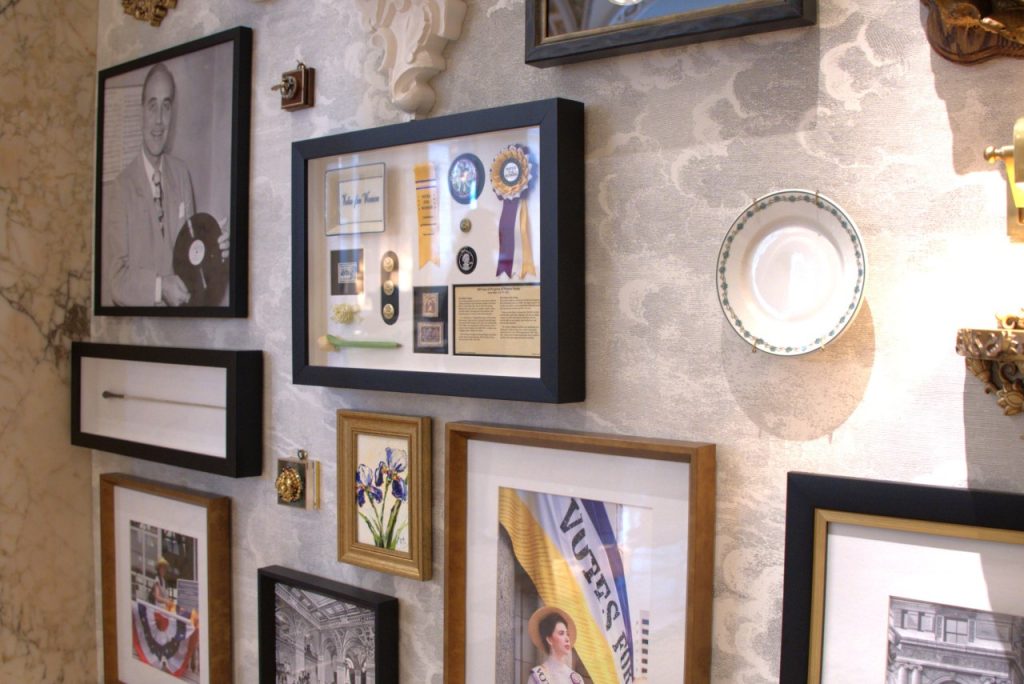
NASHVILLE, Tenn. – As Women’s History Month in March highlights the fight for equality, Tennessee is recognized as holding the most decisive moment in suffrage history. In August 1920, the state became the final political battleground for women’s suffrage, with just a single man determining whether millions of women would have the right to vote.
The center of this political fight was Nashville. In August 1920 lawmakers gathered to decide if Tennessee would become the last state to ratify the amendment.
“Tennessee became the 36th and final state needed to ratify the 19th Amendment, and that’s what made Nashville so pivotal,” Tom Vickstrom, the historian at the Hermitage Hotel said.
The outcome was uncertain. “It ultimately came down to just two states. Delaware and Tennessee, that could go either way,” he said.
Much of the action took place near the Capitol inside the Hermitage Hotel.
“The Hermitage Hotel acquired the nickname ‘the Third House.’ The Senate, the House, and the lobby of this hotel,” Vickstrom said.
The building became an epicenter for political activity hosting suffragists, those opposed to ratification and politicians alike.
“The lobby was filled with people past midnight debating, discussing, arguing. It was the center of everything,” Vickstrom said.
Inside, suffrage leaders worked to influence lawmakers. Carrie Chapman Catt coordinated efforts from the hotel, tracking legislators and applying pressure while staying out of the public eye.
“They would meet legislators at the train station with a yellow rose and ask them to pledge their vote on the spot,” Vickstrom said.
Tensions grew as both sides tried to secure support. “There were even mentions of fistfights in the lobby. It wasn’t just polite debate,” he said.
The tension led to a close vote in the Tennessee House of Representatives. Before the final decision, a motion nearly stopped the process. “Before Harry T. Burn cast the deciding vote, Banks Turner actually prevented the motion from being tabled. He’s often forgotten,” Vickstrom said.
When the final vote was called, attention turned to 24-year-old representative Harry T. Burn. He changed his position and voted in favor of ratification, securing passage by two votes. “The final vote was 49 to 47. Proof that every single vote mattered,” Vickstrom said.
After the vote, the atmosphere quickly shifted to hostility. Burn swiftly left the Capitol to avoid confrontation. He later described how people were searching for him “like a bunch of hounds chasing after a fox.” Meanwhile, supporters of suffrage gathered to mark the moment.
“They surged to the governor’s office singing America the Beautiful,” Vickstrom said.
At the Hermitage Hotel, “the celebration was described as “joy unrestrained,” with supporters honoring the “Immortal 49” who voted in favor for the 19th Amendment.
The outcome in Nashville was shaped by work happening across Tennessee, including in Chattanooga. Abby Crawford Milton was one of several women from the city who played key roles in organizing and advocacy. Her work continued long after 1920, as she later helped establish the Great Smoky Mountains National Park.
“She dedicated years of her life to winning the vote,” Vickstrom said.
Catherine Talty Kenny, also from Chattanooga, contributed to the state’s ratification effort. She was known for her ability to organize and lead. “She was said to have the brains of two people,” Vickstrom said.
Kenny’s work, along with Milton’s, reflected the influence of women who organized around Tennessee to shape the outcome in 1920.
During Women’s History Month, the story of Tennessee’s role in the 19th Amendment shows that the final vote in Nashville depended on efforts across the state. In the end, the outcome came down to two votes. The result reflected years of work by women in Nashville, Chattanooga, and beyond.
This story is part of week long news coverage of the TN General Assembly by the UT-Chattanooga PULSE Project.
Leave a Reply