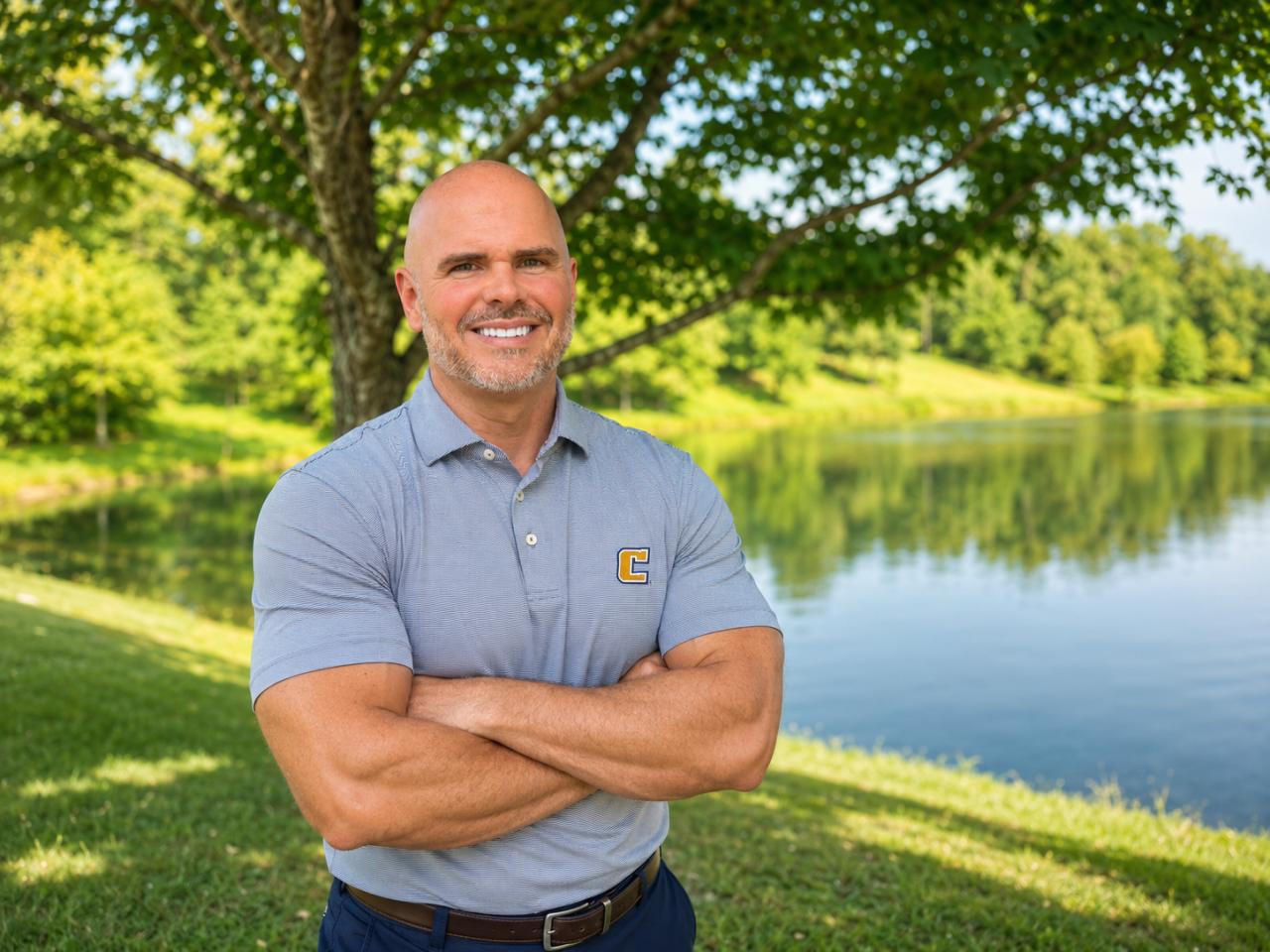
Trey White is a 2004 graduate of the Gary W. Rollins College of Business at the University of Tennessee at Chattanooga, where he earned a Bachelor of Science in Accounting. He currently serves as chief financial officer of Health One Alliance and Alliant Health Plans, based in Dalton, Georgia.
In this alumni Q&A, Trey reflects on the interview that launched his career, the UTC professor who shaped how he learns and why he considers his return to insurance a homecoming.
What excites you about your current role as chief financial officer?
I started my career with Ernst & Young in Chattanooga — a job I landed after interviewing on campus at UTC — and later earned my CPA license. From there, my career evolved from public accounting into increasingly broader financial leadership roles, including serving as vice president, controller and chief accounting officer at BlueCross BlueShield of Tennessee, and now as CFO of Health One Alliance and Alliant Health Plans.
As my responsibilities have grown, I’ve found that the accounting foundation becomes more valuable, not less. A CFO has to think well beyond accounting — about strategy, operations, people, growth, risk and where the organization is headed — but having a strong understanding of the financial fundamentals provides a framework for making those broader decisions.
What do you remember about your on-campus interview with Ernst & Young?
I was nervous, confident and unsure, all at once!
I was confident in my abilities and knew I had worked hard to prepare myself, but I wasn’t necessarily confident that my background matched what EY was looking for. My goal was to begin my career with a Big Four accounting firm, but I also wanted to remain in Chattanooga, EY was the only Big Four firm with a local office at the time. That made the opportunity especially important to me.
As a first-generation college student, I also hadn’t had much exposure to a professional environment like that. I didn’t grow up knowing how a Big Four interview worked or what that career path looked like. The accounting faculty at UTC did an incredible job preparing me — not only for the interview itself, but for those first steps into the professional world. Looking back, that preparation was tremendously valuable.
When I walked out of the interview, I thought it had gone well, but I certainly didn’t assume I had the job, or even that I would be invited back for an in-office interview. I knew some of the other candidates had stronger academic credentials on paper. What I didn’t fully appreciate at the time was that EY was looking at the whole person. I had worked full-time throughout college while still maintaining a solid GPA and completing my degree. They saw something in that experience — work ethic, determination and a willingness to take on responsibility — that resonated with them.
That experience taught me something I’ve carried throughout my career and now consider when evaluating talent myself: credentials matter, but they rarely tell the whole story. Sometimes a person’s path tells you as much about their potential as anything on a résumé.
What drew you to leave insurance for a stint, and what brought you back?
Insurance was really the foundation of my career from the very beginning. When I joined EY, I was assigned primarily to insurance clients during my first couple of years and then worked exclusively in the industry beginning in my third year. From there, I joined BlueCross BlueShield of Tennessee and ultimately spent many years there in financial leadership roles. So, by that point, insurance was an industry I knew extremely well.
At the same time, I had always been curious about what I could learn by stepping outside of it. An opportunity presented itself to join a rapidly growing company in the real estate and hospitality space that was being led by some very talented people. The timing seemed right and the growth story was intriguing. I saw it as an opportunity to challenge myself in a completely different environment.
I’m glad I did it. We accomplished a great deal in a relatively short period of time, and the experience gave me exposure to a different business model, a different pace and a different set of challenges. Working in a high-growth entrepreneurial environment also broadened my perspective as a finance executive.
Ultimately, though, it reinforced how much value there was in the industry expertise I had built over the years. Insurance is complex, highly regulated and constantly evolving. I realized that my background allowed me to make a much greater impact there. So when the opportunity arose to join Health One Alliance and Alliant Health Plans, I was excited to bring both my insurance experience and the broader perspective I had gained back to an industry I knew well. In many ways, it felt like coming home professionally.
What was the most impactful part of your time as a UTC student?
The most impactful part of my UTC experience was the relationships I built. The classroom obviously gave me the technical knowledge I needed, but some of the most valuable lessons came through conversations with professors outside the classroom. Those interactions helped me better understand what the professional world would actually look like and gave me confidence as I prepared to take that next step.
The relationships with my classmates were equally meaningful. Several of us went on to build careers in the Chattanooga region, and many of those relationships have continued for more than 20 years. Looking back, that’s one of the things I value most about my time at UTC. The education opened doors, but the people helped prepare me to walk through them.
Is there a specific professor or conversation that stands out to you?
There were several professors with whom I developed great relationships, and many have since retired or moved on to other roles. One of the things I figured out fairly early was that I learn best when I can connect a concept to how it actually works in the real world. I could understand the technical material, but it really clicked for me when I could see the application behind it.
I began spending time with professors outside the classroom, sometimes just for a few minutes after class. I would ask them to give me a real-world example of whatever we were studying. Those informal conversations were incredibly valuable. We might start by talking about an accounting concept, but the conversation would often expand into what it was actually like to work with a client, navigate a professional environment or build a career.
Dr. Joanie Sompayrac is one professor I’ll mention specifically, in part because I believe she may be one of the few faculty members still at UTC from my time there. Dr. Sompayrac always had a relatable story or a practical example that could make a concept come alive. I leaned heavily into that insight, and those conversations helped me develop much more realistic expectations about what the professional world would be like.
More than 20 years later, I’m fortunate to still consider Dr. Sompayrac a friend. We’ve stayed in touch throughout my career, which says a lot about the kind of relationships students can develop with faculty at UTC.
What would you tell someone who’s on the fence about getting an accounting degree?
One of the things people sometimes overlook about accounting is how much of the business you get to see. To be a good accountant, you ultimately have to understand how the entire organization works — not just the numbers. You gain exposure to operations, strategy, HR, technology and almost every other part of the business.
That broad perspective creates tremendous flexibility over the course of a career. Accounting can certainly lead to traditional accounting and finance roles, but it can also become a foundation for much broader leadership opportunities. My own career has taken me from public accounting to controllership, into broader executive leadership, through an entirely different industry for a period of time and ultimately into the CFO role.
If someone is interested in business but isn’t exactly sure where they want their career to take them, I think accounting is one of the best places they can start. It teaches you how a business works and gives you a skill set that’s valuable in virtually every industry. Accounting provides a foundation that can support a wide range of career paths as your interests and responsibilities evolve.
What makes the accounting program at UTC’s Rollins College of Business stand out?
With the addition of UTC’s MAcc program, I think the accounting program is more attractive than ever. Students have access to a strong academic foundation, but they also have something I experienced firsthand. The opportunity to connect that education directly to employers and professional opportunities here in Chattanooga.
Chattanooga has changed tremendously since I graduated, and the professional opportunities in the region continue to grow. Whether a student grew up here or comes to Chattanooga to attend UTC, I think there’s a tremendous opportunity to build both a career and a life here.
I benefited from that path more than 20 years ago when an on-campus interview at UTC helped launch my career. If the accounting program can continue creating those connections and helping talented students begin their careers here, that’s good for the students, good for UTC and good for the Chattanooga community.

Let’s see where business takes you.
From first-generation student to chief financial officer — an accounting degree from UTC’s Gary W. Rollins College of Business can take you further than you think. With expert faculty, professional connections that last decades, and a program designed to build leaders, your career starts here.
Explore the RCOB accounting program →
