
Dr. Mark Johnson teaches in a nutrition lab during his class “What’s Good to Eat.” Photo by Angela Foster.
Pork became embedded in American history during the colonial period.
The colonists’ failed attempt at being “proper English people”—feasting on more socially acceptable meats from orderly animals that roamed in beautiful, fenced farms—meant they relied on pigs for their protein. More specifically, bacon.
A staple breakfast food, religious condemnation, slavery and food systems, overly priced boutique doughnuts—all of it traces back to the complicated history of bacon.
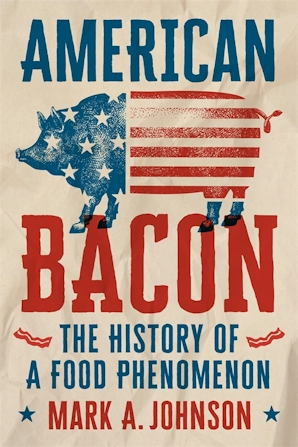
This history is what Dr. Mark Johnson, an assistant professor of history at the University of Tennessee at Chattanooga, traced for years to write his new book, “American Bacon: The History of a Food Phenomenon.”
*****************
Mark Johnson will host a Q&A session and “American Bacon” book signing at 4 p.m. on Monday, April 6, in the Guerry Center Reading Room. Click here to learn more.
*****************
The book had been on his mind since 2013 when he was working on his previous “food” book, “An Irresistible History of Alabama Barbecue: From Wood Pit to White Sauce,” which was published in 2017.
“I’d been stashing away an article where there’s a picture of a maple bacon doughnut,” Johnson said. “In 2019, when I started at UTC, I was able to finally get back into academia and had the resources—and the library—to go to archives.”
He wanted to know how something so ordinary ended up everywhere.
For much of American history, bacon was only a sparingly used garnish. It was added to greens, stews or cornbread for the flavor. Johnson points to those everyday uses, especially in the South, where bacon often stretched meals for enslaved people and later for sharecroppers.
Johnson said the bacon evolution is unusual compared to other similar food items.
“We don’t get that obsessed about our mundane staples,” he said. “The argument in the book is that bacon had to die in a way.”
By the early 2000s, it had worked its way into foods and drinks that had nothing to do with its original purpose (doughnuts, cocktails, brunch menus). Johnson said that shift may be due to changing health advice and cultural pushback against bacon.
“People are kind of fed up with this,” he said. “If we’re already sinning or doing something that’s bad for us, it’s kind of like, might as well go for it.”
The same food that had once been dismissed or avoided, whether for religious reasons or because it was associated with laboring classes, was now showing up as a small indulgence.
This is what Johnson said makes bacon worth studying. It’s also something he enjoys teaching. In his “Food and Southern History” class, students made bacon themselves.
“I wanted to do something in my class that got them hands-on experience,” he said.
Working through the process gave students a way to think about how food changes over time, in terms of taste, labor, cost, and meaning.
“I can teach some real and sometimes hard history,” Johnson said, “but if bacon is a way to get you in to learn about how we’ve thought about ideas of race and diet and gender and body image and health and wellness … that’s why it’s titled the way it is.”
Ultimately, the book is not about food.
“It’s really a story of the United States and how bacon gets all tied up in it,” Johnson said.
Johnson’s book, published with the University of Georgia Press, releases on Wednesday, April 15, and is now available for pre-order.

Mark Johnson hosted a Q&A session and “American Bacon” book signing in the Guerry Center Reading Room.
Learn more
Photo gallery by Angela Foster


